
Boundary Layer Effects
Viscous losses and nozzle wall displacement due to boundary layer effects
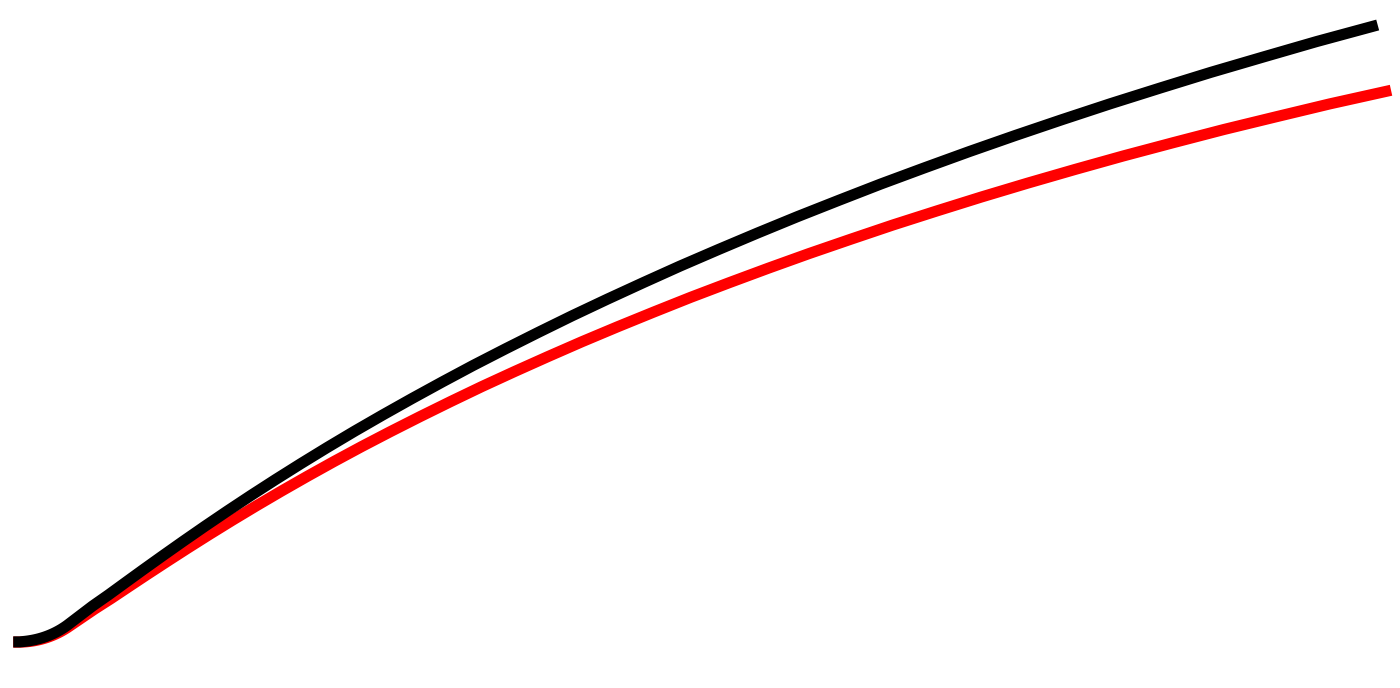
Boundary Layer Modeling
To account for boundary layer effects, NozzlePy applies the Blasius laminar boundary layer formulation.
Boundary Layer Thickness:
Boundary Layer Thickness: The Blasius boundary layer thickness is computed as a function of the local dynamic flow viscosity. Since the flow within the Blasius boundary layer is assumed to be at rest relative to the wall, the calculated nozzle contour is expanded accordingly in order to preserve the same effective flow expansion as in the ideal nozzle case.
Boundary Layer Performance Loss:
The shear force induced by wall friction within the boundary layer is evaluated by integrating the wall shear stress along the nozzle contour. The shear stress is determined using the local density, local flow velocity, and the local friction coefficient.All boundary layer calculations currently assume a purely laminar flow regime. Support for turbulent boundary layer modeling will be introduced in a future update.